
Standout Songs:
Genre:
Label:
Year:
Date Reviewed:
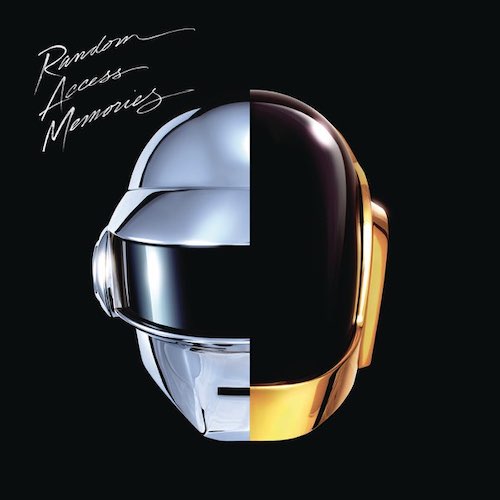
My relationship with Daft Punk's final record, Random Access Memories, is a bit of a checkered one. I remember hearing the announcement that Daft Punk was returning after eight years of studio album silence and instantly being filled with excitement. Then I saw the teaser to the Pharrell Williams and Nile Rodgers-assisted cut Get Lucky, and thought that the stark shift to less synthetic instrumentation was kind of interesting. Then the song was finally released, and seeing as I worked at a record store at the time, I heard that song - along with Pharrell's mediocre singing - at least ten times a day up until the album's release. My anticipation was slightly soured. However, somewhere in between this and the record's release, promotional material started rolling out, revealing more of the album's guests: Julian Casablancas of The Strokes seemed like an intriguing pairing given the different worlds those artists respectively occupied, I was happy to hear of Panda Bear's (Animal Collective) involvement given that his boyish croon hits my ear in just the right way, Todd Edwards (who contributed vocals on Daft Punk's classic album Discovery) also makes a return, and of course we can't forget an appearance from disco legend Giorgio Moroder. I was really looking forward to this again.
The album finally came into my store. I'm in the stock room cracking it open and putting it on the stereo, excited for this long-awaited record to soundtrack my day. Give Life Back to Music comes in with those punches, dramatic pianos, the steady strum of a clean guitar, and rising synths. And then it all disappears, making way for an ultra clean groove. The production is immaculate. Pristine drums playing a steady four-on-the-floor groove, accented hand claps, a tasty palm-muted guitar riff, and some soothing chimes placed subtly in the background. You wouldn't know it was a Daft Punk record until the familiar voice of the robots comes in. I continue to listen through the album, and I'm really just taken aback by the sound. Every element is presented in stunning high-definition and even in its busiest moments like the climactic finish to Giorgio By Moroder, each layer can be heard in crystal clarity. To this day, it is still one of the best engineered and mixed albums I think I've ever heard. On the day it was released, I bought the CD, I bought it on vinyl, I just thought it was amazing.
The more I listened to it though, I started to feel like my valuation of Random Access Memories was maybe a little too generous. I was originally captured by the sound; everything on a technical end was perfect. Once the afterglow faded away and all that was left were the songs, I started to feel like I maybe wasn't as into this record as I originally thought. The three Rodgers' cuts (Give Life Back to Music, Lose Yourself to Dance, and Get Lucky) all had great grooves but not a lot of instrumental development. At five-six minutes in length, they started to become quite monotonous. I also wasn't really impressed with Pharrell's vocals on the latter two. I thought his vocals, especially in his upper register, were pretty weak. I felt similarly about Todd Edwards' vocals on Fragments of Time, although, perhaps that's more of a technical issue. His voice was incredibly dry in the mix and I didn't think it sat very well amongst the slightly reverbed, country twang of lap/pedal steel guitars. This lengthy album started to get into the weeds a little by the end with Beyond and Motherboard. The former seemed really unnecessary considering we already had two emotionally potent slow jams in the first half of the record (The Game of Love and Within), and the latter felt like a misplaced interlude that maybe could've been more effective if it was condensed and sequenced better. Essentially, the deeper I dove, the spottier I felt the record had become.
The vinyl sat unlistened on my shelf for many years, and I'm sure I parted ways with the CD at some point over the last ten years. But now that the tenth anniversary edition is out and all this behind the scenes material is seeing the light of day, I decided to dust off the ol' vinyl copy and give it a spin. Distance from Random Access Memories for so long allowed me to hear the record with a fresh perspective, and I think I wound up meeting somewhere in the middle of my two initial evaluations. I'm still really impressed with the sound and production on this record; I think in many ways it is unrivalled. It so closely emulates the disco sounds of the 70s, but has a modern sheen that feels only possible thanks to forty years of recording advancements and knowledge. Giorgio By Moroder is still mind-blowing today the way it has its foot simultaneously in house, disco, classical, and progressive rock. The main arpeggiated motif is still incredibly catchy, and the epic turn it makes into this incredibly raw and energetic jam complete with a masterful drum performance honestly leaves me speechless. The song also serves as a touching homage to a true trailblazer who was fearless in his musical pursuits, much like how Daft Punk demonstrates on this particular track. Instant Crush is still the album's best track. Julian Casablancas, known for his gruff, garage rock vocal style, sounds incredible with vocoder applied to his more cleanly sung delivery. The chorus is super strong with a killer vocal melody, more dramatic synth chords, and a pumped up funk bassline. I still love Doin' It Right, which feels like the most Daft Punk moment on the record. The robots' vocal hook is supremely catchy, the kicks are deep and resonant, and Panda Bear's voice soars over with an easily imitable ascending and descending vocal melody.
Listening back to this gave me a new appreciation for the album's centrepiece Touch. It's this multi-phased odyssey that has you feeling like you're going through hyperspace initially. Then the song blooms into what I can only describe as a celebratory ragtime number followed by a reflective and emotional breakdown before ending with a lush suite of synth arpeggios, strings, and children's choir. It is quite the cinematic epic. And lastly, I would also have to say I warmed up to both The Game of Love and Within, the two emotional, robot led slow jams. There's no denying that even with all those vocal effects, you can still hear the sadness and confusion in those performances. Those feelings are palpable, translated beautifully. And honestly, I think that pretty much sums up what is special about this record. If the goal all along was to become thinking, feeling, breathing machines, then the robots really hit it out of the park with Random Access Memories. It's very fitting that this album is the final chapter for Daft Punk because I'm not sure you can craft a more genuine human experience in the house/dance genre.