
Standout Songs:
Genre:
Label:
Year:
Date Reviewed:
It doesn't happen often these days given the current exploitative, attention starved, and bot-thriving state of the internet. But every once in a while it manages to get things right. A little while ago, my Instagram feed served up Garrulous Glass, a very fun instrumental progressive rock project. The connection was likely made because of my close proximity to Pieter Kamps, who spearheads the project out of a lesser-known community just on the opposite outer edges of the Greater Toronto Area. Not only did the algorithm correctly assume that I'm always on the lookout for wild rock music, but I'm also up for being put on to local talent. As if the internet couldn't score more 'Ws,' Kamps is rhythmically supported by drummer Chris Bohm, based all the way down in Austin, Texas. Despite the more than 2,000 kilometers spanning between them, they're able to come together to bring Kamps' vision to life.
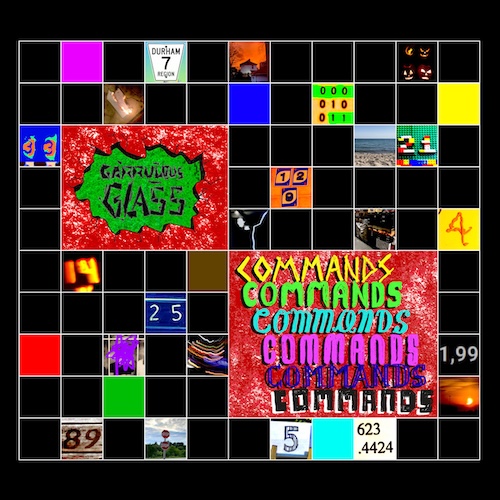
Their first record, Commands, sounds like a project deeply informed by the riff-dense, effects-laden, punky progressive rock that cropped up in the mid-2000s. Underground math rock milestones like Tera Melos's Untitled or Piglet's Lava Land EP feel like immediate sonic reference points for Kamps. These are records I am particularly fond of due to how unpredictable, fantastical, and intriguingly melodic they are; all qualities that Kamps adequately displays in his compositions.
The key that unlocks all of these qualities within Commands are the variety of operational modes the record can unexpectedly shift into. At no point does the record feel like it occupies any one distinct lane. Tracks like "Remember Me?" and the title track represent math rock's nostalgic, more energetic side, characterized by distorted riffs that focus more on the intricacies of time than performance. Yet, the album also nods to the modern state of math rock; intricate riffs showcased through hyper-clean, almost glassy tones. An example I can point to would be some passages of Intentionally Misplaced Apostrophe which evoke the elegant, fluid fretwork of contemporary acts like COVET.
Without forewarning, the project can also pivot into much more aggressive territory. Brandon's Drunk Birthday Song is bookended by these thrashy, mathcore passages where hardcore riffs and panic chords collide while double-kick drums pound away underneath. Visions of Jack O'lanterns retains the menacing pretense, although with a meditatively groovy, single-note riff, it has that djenty bounce to it; just ignore the absence of extended range, detuned guitars.
These energetic peaks are balanced by calm, post-rock reprieves that pop up at various points throughout the album. The gain is rolled down, the tempo slows to a therapeutic crawl, and subtly nimble bass licks may even take center stage. Returning to Intentionally Misplaced Apostrophe, the song structures become so deconstructed and minimal that the music encroaches on pure ambient territory. The swelling guitars in the opening minutes are a particular highlight as you can clearly hear the physical onset of each chord, but the immense reverb trails immediately melt the notes into a gorgeous, indecipherable sonic stream.
For the most part, every single flavor Garrulous Glass throws at the wall sticks. A big reason why Commands succeeds so thoroughly at pulling together all these different vibes is the exhaustive, painstaking effort Kamps has poured into his guitar processing. Rather than relying on a handful of pre-established tones that will loosely match the vibe he's aiming for at any given moment, it sounds as though the tone for every single musical idea and individual riff had to be built from scratch. If you are a self-proclaimed effects junkie, you can easily spend hours replaying these tracks just to analyze and reverse-engineer the signal chains. The point of course is not to appeal to toe-tappers or pot-tweakers, but rather to ensure that each part is presented exactly how it was envisioned in the world of Garrulous Glass. To that end, I think the amount of labour that went into it certainly paid off.
While I wholeheartedly praise the attention to detail in the guitar tones, Commands is uncompromisingly a guitar-focused record that occasionally comes at the detriment of the other instrumentation. The bass guitar, for instance, consistently retains a hyper-scooped tone. While the tone allows its nimble, technical phrases to peek out in key moments, the instrument can feel devoid of a unique voice. I would have loved to hear some of Kamps' tone experimentation rub off on the bass tracks, especially during the minimalist moments where there is sonic real estate for a more unusual bass presence. Similarly, while it is admittedly much more difficult to get tastefully freaky with drums and effects, I occasionally found myself wishing that the drum parts were as eccentric as the guitar arrangements.
On a broader production note, the main element holding these tracks back is a distinct lack of spatial independence between the left and right channels. For the vast majority of the record, it feels as though only one singular guitar part was written for a section and then simply double-tracked on both sides. Sometimes you get some really cool call-and-response moments, like on the opening track Remember Me?, that provide a greater sense of a stereo space. However, what the record is really missing is a differing guitar perspective. Whether it's adding a new melodic counterpoint to the arrangement, or simply giving one side a distinct personality in the performance, creating more separation between the stereo channels would create a wider, more rich experience. Although, I acknowledge how difficult that can be when one person is largely responsible for writing the material.
With those minor complaints aside, Commands remains a fairly impressive album that honours the adventurous spirit of mid-2000s instrumental progressive rock. You can tell Kamps' poured so much of himself into this project, and thankfully, he has some great folks in his corner to help bring his vision to life. Bohm on the drums provides not only adept performances, but the tone of his drums sound perfectly apt, and mix and mastering engineer Luc Chiasson handled the tough job of balancing the myriad of different guitar tones. He managed to keep this album sounding cohesive and consistent as it traveled drastically from one idea to the next. In a landscape where a lot of instrumental, math rock now sounds unimaginatively stale, inhumanly polished, and chases tone trends, Commands is a breath of fresh air.