
Standout Songs:
Genre:
Label:
Year:
Date Reviewed:
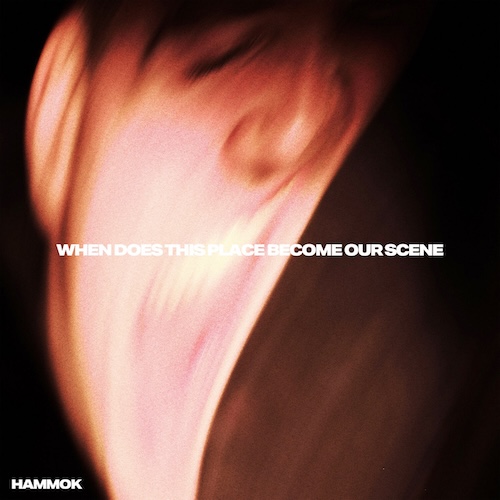
Ever since discovering Honningbarna last year, I've tumbled down a rabbit hole of spectacular, noisy Norwegian punk and post-hardcore. Each band I found, in their own special way, has felt fresh, exciting, and has reinvigorated my love for these sounds. It's becoming increasingly clear to me that Norway's scene is a hot bed of talent that shouldn't be overlooked. I think Sargent House, a label who's consistently had their pulse on what's causing a stir in the underground, have tapped into this phenomena, leading to the signing of Oslo's Hammok and the announcement of their second record When Does This Place Become Our Scene. It quickly proved to be a great acquisition as the promotional campaign yielded one fiery single after another, as well as a series of rowdy pop-up performance videos. History seemed to repeat itself as that familiar sense of exhilaration I felt with Hammok's contemporaries once again began to set in. If the rest of the album was just as good as the promotional material, there was a high chance that the honour of my album of the year would be returning to Norway. I set very high expectations, but I'm pleased to say that Hammok managed to meet them.
A major reason why When Does This Place Become Our Scene succeeds so spectacularly is that Hammok's songwriting toolkit runs incredibly deep. You've got post-hardcore's typical razor-sharp chord progressions played in jagged rhythms on tracks like The Scene, while "Blast Off (Blast Off) Blast Off" flexes mathy, angular guitar riffs that disorient. With the help of downshifting pitch effects, the band explores supremely heavy territory with lumbering, sludgy walls of guitar on Gooning For Free, as well as some truly explosive breakdowns at the end of BANG. Just as a forewarning, exercise caution with the latter, as playing it on the right (or wrong) stereo system may have adverse effects on your room's structural integrity.
On Thirst, the band demonstrates that they can strip away the chaos and deliver something that is more bass-driven, and menacingly groovy. It feels like a scuzzy version of a Death From Above 1979 track. Meanwhile Semi-Automatic Machines demonstrates that the band isn't afraid to incorporate some auxiliary instrumentation. The violins in the chorus give the track a thrilling orchestral spin that makes me feel like I'm listening to a screamo version of Los Campesinos.
This instrumental versatility is perfectly matched by the depth of Tobias Osland's vocal performance. There are distinct levels to his delivery; he can employ a snotty, punk inflection best exemplified during the verses of Tap Water, and he can shout passionately, just barely achieving that fried breakup. The main mode, however, is a satisfyingly saturated scream that sounds both healthy, yet emotionally fraught. This vocal dexterity keeps the record from ever feeling monotonous.
I can continue to praise the versatility by shifting focus to the band's backbone, Ferdinand Aasheim behind the drum kit. His parts are immensely creative, routinely dodging the most obvious or predictable grooves in many instances. One of my favourite drum moments occurs on Groundbreaker where Aasheim launches into a surprisingly speedy passage, hinting that he may have some jazz chops in his arsenal. You can hear a great deal of articulation in his playing, especially on tracks like CND where his groove is rife with ghost notes on the snare. And of course, you can't have a noisy, thrashy, punk record without a blast beat thrown in somewhere. Aasheim nails that, specifically on the closer, For My Friends.
While the performances and songwriting are stellar, this is really only half of Scene's story. The production and mixing elevate these tracks into something far greater than the sum of its parts. Much like Honningbarna, Hammok doesn't view the studio as a tool to polish, sanitize, or perfect. Instead, they weaponize the production in an almost destructive manner; unapologetically committing to bold, abrasive textures and tones to carve out memorable sonic moments.
The most noticeable manifestation of this philosophy is how the mix establishes stark dynamics from section to section. This isn't just a simple shift in volume; it is a fundamental shift in the vibe. During the album's quieter, tense passages, the instrumentation intentionally sounds thin, dull, dry, and starved of saturation. Then, when you reach those climactic moments, it's like all those obstructing filters are removed, projecting a monolithic, expansive wall of vibrant color. Semi-Automatic Machines and Blast Off (Blast Off) Blast Off are prime examples of this spatial dichotomy. The former especially as those violins sound piercingly bright. This effect can also be accomplished by removing foundational elements entirely from a mix. For example, during the bridge of The Scene, the bass guitar completely vanishes, leaving a washed-out, soaring guitar solo to float over the drums. Without the anchoring low-end, the production feels rather hollow, which makes the bass's sudden re-entry leading into the final chorus hit with twice the physical force it would have otherwise.
These production and mixing elements are the most obvious, but there's much more to discover here. In fact, it appears that nearly every second of this record has been meticulously handled, yielding intriguing little micro-details on every repeat listen. Whether it's bombing the soundscape with fat sub-explosions that momentarily obliterate the entire mix on Gooning For Free, catching you off-guard with a perfectly timed vocal delay throw on BANG, or mimicking the frantic squawk of a free-jazz saxophone with what sounds like high-rate RF radio interference on CND, the album feels truly alive and unpredictable. Admirably, Osland handled the album's production, and despite how painstaking the process likely was, I think his ambitious vision was perfectly captured.
If there are any minor gripes to be found across this magnificent showing, it could lie in the track sequencing. The last minute and a half of Groundbreaker feels a tad unnecessary, if only because the preceding track, BANG, also opts for a detouring coda. While they aren't executing the exact same idea—with BANG concluding on an earth-shattering series of heavy breakdowns and Groundbreaker embarking on a rumbling, cinematic build—placing them back-to-back represents the only instance where the album feels like it is stepping on its own toes. Additionally, while they are perfectly fine additions on their own merits, the album's final three tracks do feel slightly less impactful than the front half. However, this can easily be chalked up to ear fatigue or a waning attention span; When Does This Place Become Our Scene is a fiercely loud, noisy, and taxing listen that rarely offers the audience a single second of reprieve.
In all honesty, to find anything wrong with When Does This Place Become Our Scene, one would have to strain real hard. Every element of this record—the thrilling songwriting, the lively performances, the moment creating mixing and production—it's all working in tandem to craft a bold and assertive piece of work. It further establishes the precedent that Norway is just doing it differently. Doing it better. While I imagine the band doesn't want to jump into a new recording venture any time soon, I'm really excited to see how Hammok may evolve in the future with the partnership of Sargent House.