
Standout Songs:
Genre:
Label:
Year:
Date Reviewed:
While I have yet to fully fall in love with a JPEGMAFIA project from front-to-back, every single album cycle yields a handful of tracks that I end up completely obsessing over. These tracks routinely stand as some of the absolute best hip-hop cuts of their respective years. Because of this, I have always held an immense amount of respect for Peggy. I deeply admired his uncompromising artistic integrity, a quality defined by his continuous pursuit of whatever felt true to him, regardless of how anyone might receive it. That fearless independence was precisely what I, and I'm sure many of his fans, championed. With the arrival of EXPERIMENTAL RAP, however, his image may be on the line.
The shift began when Peggy chose to collaborate with his musical idol, Ye (formerly Kanye West), amidst the latter's antisemitic behaviour. This has understandably ruffled feathers given that Peggy has been critical of Ye's actions, and also seems incongruous with the politics of Peggy's music. Peggy's image continued to suffer hits as the promotional cycle ramped up. Completely without provocation, Peggy began firing both explicit and implicit shots at beloved artists Earl Sweatshirt and The Alchemist. While being antagonistic is hardly out of character for him, that vitriol has traditionally been aimed at entities we could easily paint as the 'villain.'
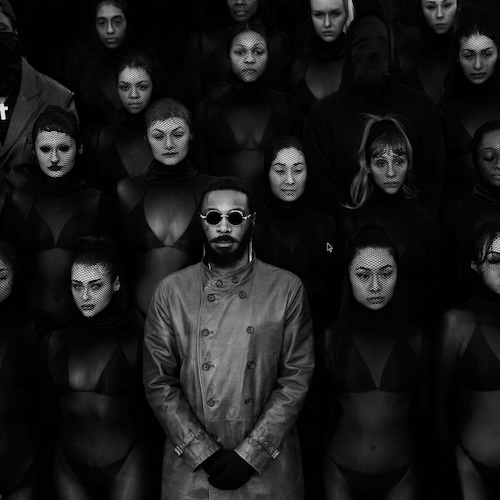
Worse still, these highly inflammatory statements were all deployed to lay claim to a hypothetical 'throne of experimental rap;' a crown that literally no one else is actively competing for. The arrogant, out of touch statements, the aggressive all-black aesthetic, and the masked posse in tow all project a cringe 'cult of personality' that concerningly follows in the footsteps of his aforementioned idol. All of these events have started to rub even his most loyal fans the wrong way, inadvertently, placing a massive weight on the upcoming album. EXPERIMENTAL RAP can no longer be a run of the mill JPEGMAFIA album, it has to carry the burden of proof.
When trying to digest the bars on EXPERIMENTAL RAP, it initially sounds like Peggy is, in fact, coming with something to prove. Much of the album is delivered in a relentless, triplet flow that admittedly sounds fiery and mesmerizing, although can make it rather exhausting to keep up with. But while the sheer volume of words flying at you suggests an artist with a lot on his mind, peeling back the curtain reveals that he isn't actually saying much of anything at all. When you boil it down, the lyrical content of this record can be reduced to the following: Peggy will steal your girl, he likes his football and wrestling similes, he owns guns and is not afraid to use them, and he thinks your music is trash. Whenever he broaches topics with the potential for real, insightful commentary, the execution is either too shallow or buried beneath painfully inflammatory statements with the sole purpose to elicit a shocked reaction.
The first missed opportunity concerns his connection to Ye. While I don't think fans are owed an explanation regarding his choice to collaborate with him, Peggy continuously alludes to West without offering an ounce of meaningful context. It would have been genuinely fascinating to hear if his perspective has evolved since his deleted tweets on the matter. There's even a track titled Since I Met Ye, a song in which Peggy completely ducks the prompt, and baits his audience instead.
Attempts at provocative social commentary also fall flat. The opening monologue of GYBB somewhat revives Chris Rock's iconic, highly controversial "Black People vs… " routine. Peggy draws a line between himself and street rappers, going so far as to call himself racist. Delivered without a single shred of irony, let alone Rock's sharp comedic intuition, the artistic merit of the bit is lost on me, and simply comes across as uncomfortable. On The 1st Amendment, Peggy litters this tune with lazy Charlie Kirk references. It's glaringly transparent that Peggy is farming reactionary online outrage.
The only moment where Peggy appears to be somewhat topically focused is on the track Chat, though even this one will understandably raise some eyebrows. Here, Peggy bypasses standard critiques of systemic police brutality and calls for violent retribution. Dedicated to Rodney Hinton Jr., the Ohio father accused of intentionally running down a retired sheriff's deputy after police shot and killed his eighteen-year-old son, Peggy uses the track to demand that convicted, murderous police officers be released into the public explicitly so they can be hunted down like dogs in the street. Needless to say, this is a radical stance that probably won't facilitate civil conversation. But given that EXPERIMENTAL RAP is largely banal, Chat stands out because the ire is genuine and targeted towards an actual oppressive institution.
If there is a saving grace to EXPERIMENTAL RAP, it's that the production is quite decent, possibly some of my favourite instrumentals yet from Peggy. However, for a record that, again, is attempting to dominate the sub-genre, the production is only marginally more daring than what he has given us on past projects. He is still comfortably leaning on his signature toolkit: obnoxiously repetitive vocal loops, glitchy digital noise, aggressive hard-rock textures, and soul-stirring gospel flourishes. Whenever he does try to genuinely expand his sonic palette, the results are mixed. The album at points attempts to inject a sense of cinematic grandiosity that is often quite breathtaking. Although, this record also incorporates cliché brostep drops. But these elements aren't inherently revolutionary, they are just new to him.
Similar to I Lay Down My Life For You, I've been gravitating to the classier, more measured instrumentals on this new record. On Pop This Heat, Peggy delivers a track with percussive piano chords, a smooth bassline, gentle side-sticks, and tasteful lead guitar lines. War Over Land expands on this, elevating the stakes with lavish, sweeping string arrangements juxtaposed against flashier, shredding guitar solos. In terms of measured approaches, I don't think you'll find an instrumental more chill than New Era. Built around one of the few genuinely discernible rhythms on the record, the track blends soft vocal pads, nostalgic video game sound effects, and delicate acoustic guitar. In a truly unexpected fashion, the outro does erupt with exhilarating, blown-out shots of pop-production that are exhilarating. Complemented by a rare moment where Peggy consciously switches up his flow, it is an undeniable highlight.
Tracks like TSAR BOMBA and Lights continue to demonstrate Peggy's sample flipping chops. The former's instrumental is lifted entirely from obscure Chicago metalcore band We Weren't Invited, and brilliantly channels squealing guitars, beatdown riffs, and raw a capella screams into one of his most aggressive cuts. The latter flips the very well known horns from Ye's All of the Lights, yet with a different rhythmic cadence and more epic lead guitars, Peggy manages to put enough of an original spin on it to make it his own.
My absolute favourite instrumental on the record happens to be Burning Hammer, a track that production-wise is the closest Peggy comes to earning the title of experimental rap king. It's a spellbinding collage of EDM risers, cloudy, sci-fi trap production, and flamenco-styled guitar passages. Just when you think the production couldn't be more varied within a single track, Burning Hammer culminates with an anthemic arena rock finale.
Yet, for all its brilliant execution, EXPERIMENTAL RAP is still dragged down by some frustrating production choices. As previously mentioned, the brostep passages, in addition to sounding very dated, are just plain awful. Furthermore, Peggy's reliance on hyper-chopped vocal loops, long a staple of his production style, continues to be obnoxious at points. My least favourite example appears on The Ghost of Emmett Till. The instrumental track itself is fantastic on its own merits, but Peggy clutters it by haphazardly pasting in a Bunny Sigler vocal sample (previously utilized by Ye for one of my favourite Pusha T tracks). The sample's interjections offer nothing in the way of enhancement, instead it just distracts.
JPEGMAFIA might've implicitly promised a project worthy of the experimental rap throne, but the result is just another by-the-numbers record in his catalogue. The production is only marginally more adventurous than previous projects, yet his recycling of flows and lyrical tropes suggest that Peggy hasn't really evolved at all. For those who didn't seriously consider him taking up the hypothetical mantle, life goes on. However, for his loyal fanbase who hoped that he would back up his arrogant statements, they may justifiably feel rather disappointed.