
Standout Songs:
Genre:
Label:
Year:
Date Reviewed:
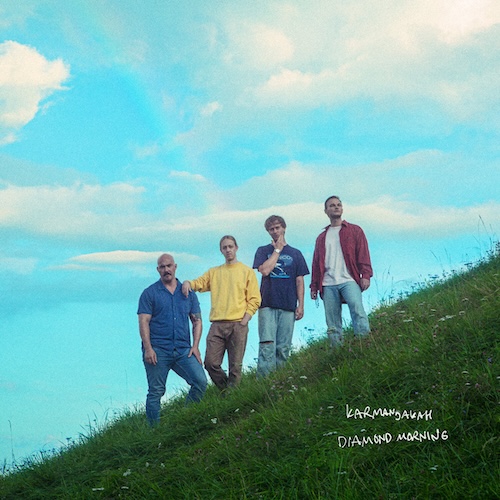
In today's musical landscape, mixing metal with dreamy, cinematic post-rock is nothing new. In fact, it is almost a prevailing trend at this point. Despite the saturation, Sweden's Karmanjakah still manages to put their own fresh, vibrant spin on the genre fusion. On the heavier side of things, the band employs a lot of djent-styled guitars with a crushing amount of low end, as well as that 'THALL' sourness associated with their fellow countrymen. These particular sounds aren't all that novel, but this is not how Karmanjakah forges a new path. Instead, the band places much more emphasis on the heavenly components of their sound: triumphant, soaring guitar melodies, atmospheric soundscapes, and gentle, cinematic reposes.
The largest contributor to Karmanjakah's inviting nature is vocalist Jonas Lundquist. In a genre that expects harsh vocals, or at the very least, clean vocals that are pushed to straining limits, Lundquist is the complete antithesis. The character of his voice has no dirt, no grit; just pristine, clean power. When I think of his vocal style, the term adult-contemporary comes to mind. Not in a sterile, doctor's office waiting room way, but in a refined, widely appealing way. Combined with the heavenly emphasis in the instrumentals, Karmanjakah may just be the perfect answer for those who want to feel the immense power of modern progressive metal without being subjected to extreme metal's more abrasive tendencies.
The opening leg of Diamond morning really displays the band's expansive reach. Interestingly, the record opens with an aggressive anomaly. It busts the door down with blistering blast beats and tremolo-picked guitar leads. The riffs are a tad menacing and the energy is relentless, yet Jonas Lundquist's ultra-clean vocals work absolute wonders here, effortlessly cutting through the tension. From there, the band pivots into the deeply melancholic, post-rock-inflected Eyes Seeing Eyes. Beginning intimately with just a piano and Lundquist's delicate performance, the track unexpectedly explodes into a massive, full-band arrangement that boasts spacious breakdowns played at a contemplative pace, and wailing tremolo-picked guitars that slowly bend in pitch. The climax on this track is incredible as we get these brief spurts of punishing rhythms between, if I can borrow an EDM term, guitar risers. At the beginning of the riser, if I were to guess, guitarist Viggo Örsan palm mutes to cut off those harmonic overtones, and then slowly eases up on his palm to gradually introduce them back in. It's a small detail, but it's creative and greatly adds to the track's grandeur.
The momentum carries over on to Sun, astray, undisputedly the album's crown jewel. It kicks off with a catchy, palm-muted riff that has a distinct Deftones flavor, before blossoming into a deeper, low-register dirge backed by militant percussion. The song's major draws include the precise pitch-bend in the main riff that stings gracefully, and Lundquist's very powerful belts that showcase his impressive vocal range. The songwriting here is beautifully unpredictable; just when you expect another massive chorus, the instrumentation completely drops out, leaving only an acoustic guitar and a whisper-soft vocal reprise. The band crashes back in unexpectedly, riding out the rest of the track with a gorgeous guitar solo. The adventurous Thousand Horns rounds out this stellar opening run, standing as the album's most progressive moment. It weaves majestic melodies through unexpected start-stop dynamics and curious chord progressions that refuse to conform to a key. It is an incredibly mesmerizing track that would be easy to get lost in, which is why the band's decision to occasionally reprise the opening tremolo-picked melody is a genius bit of songwriting. It offers the listener a vital sense of home base, anchoring them through the stormy composition.
Unfortunately, once the record crosses into its back half, Diamond morning begins to reveal a troubling lack of foundational ideas needed to sustain a full-length release. This drought is initially masked by a pair of brief instrumental interludes, Sapphire and Ruby. The former starts like an outtake from a Periphery tune before gracefully transitioning into an unsaturated, jazzy piano-and-drum section filled out by immersive field recordings. The latter features a hyper-clean, extended-range guitar performing more of a classical piece while experimenting with neat pitch effects. Both pieces sound really cool, but they ultimately feel like a tease. These ideas, if fleshed out into fully realized songs, would have further showcased Karmanjakah's musical scope. Instead these two tracks feel more like undeveloped fragments.
Then there's the three-part Diamond suite, where the lack of ideas manifests to an even greater degree. The first part, Diamond morning, once again shows off those surgically precise bends, this time building an entire riff around the technique. The final leg, Diamond train, offers even flashier guitar work, with fantastic hammer-on/pull-off runs that are deeply engaging. The problem with these two tracks, however, is that the structures become predictably formulaic. The two tracks simply alternate between quiet, more restrained passages designed to highlight Lundquist's vocals, and louder metal passages where the guitars get their time in the spotlight. In the case of Diamond train, which measures nearly eight minutes in length, this routine back and forth makes it easy for the listener to tune out.
Frankly, I should've seen this coming. If you rewind back to Moon, astray in the first half, you'll find a needless four-minute addendum to the album's best track. It feels like an interlude that simply refuses to end, driven by a drab acoustic guitar, ghostly background swells that add zero interest, and a drum beat that feels like it's merely going through the motions.
What's perhaps more frustrating concerning the band's lack of ideas, is how much they pride themselves on their diverse musical backgrounds: drummer Sebastian Brydniak has a jazz background, bassist Lukas Ohlsson is said to have experience in the classical world, and Lundquist used to rap. These influences and expertise could make Karmanjakah's music even more unique, except that the moments in which the band leverages these individual strengths feel compartmentalized in these brief interlude tracks as opposed to being imprinted within the band's DNA. The album's core tracks, aside from the uniquely accessible brightness, doesn't exactly offer something new in terms of metal songwriting or production.
At the risk of immediately contradicting myself, there is one element that could be left out, or at the very least, remodeled. That is Lundquist's rapping. On the already suffering Moon, astray and the middle part of the Diamond suite, Lundquist drops some fairly drab verses. His flow is uninspired, his delivery lacks personality, and the rhymes offer very little revelation. I'm not sure I have a solution on how to effectively incorporate the rapping; a more lively delivery could clash with the band's serene aesthetic, or worse, fall into cringy nu-metal territory. All I know is that the incorporated hip-hop elements aren't working in their current state.
Karmanjakah has stumbled onto a genuinely original aesthetic by leaning into the heavenly branch of modern progressive metal, but they have the know-how to be even more radical. If they can actually fuse their individual influences in a heavy context, they could create an even larger splash. For now, Diamond morning remains an album of two halves: a breathtaking, front-loaded display of progressive metal majesty, and a back half that suffers from creative exhaustion.