
Standout Songs:
Genre:
Label:
Year:
Date Reviewed:
In 2011, a friend of mine sat me down to watch The Art of Flight, a snowboarding film that was supposedly a major event for the sport. Little did I know it would turn out to be one of those formative musical experiences. Instead of the left-of-centre alternative rock that often scored the gritty skateboarding, BMX, and aggressive inline footage I was familiar with up until that point, this movie paired breathtaking shots of vast mountain ranges with fittingly more cinematic sounds. One of the more prominently featured artists was M83, a post-rock, 80s-tinged dream-pop project spearheaded by Anthony Gonzalez. I wasn't familiar with M83 prior, but after being stunned by the three songs Gonzalez contributed to the film, I knew this was a lead I had to follow. As it turned out, these tracks were from his yet to be released sixth album, easily making it one of my most anticipated albums at the time.
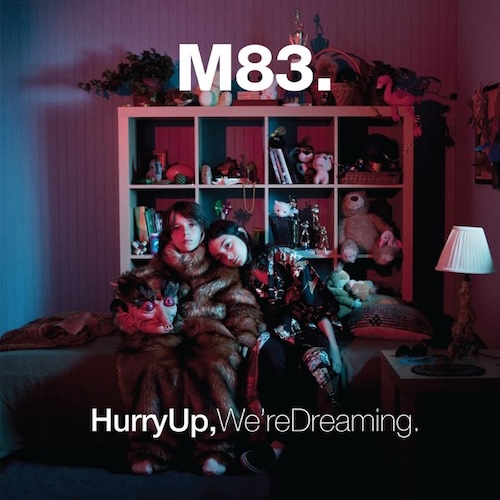
From the very first play, I immediately became infatuated with Hurry Up, We're Dreaming. It became this child-like obsession where I played it exclusively and incessantly for a concerning period of time; much to the chagrin of my roommate. I couldn't help it though, the sweeping double album was unlike anything I really experienced up to that point. The world Gonzalez and his collaborators constructed was expansive, utilizing a lush mix of organic rock instrumentation and dreamy synthesizers. What amazed me is how effortlessly the album shifts between sonic worlds without ever feeling disjointed. The album can traverse exhilarating arena rock jams, synth-pop with a touch of 80s nostalgia, and contemplative ambient interludes, yet the meticulous production binds it all together with remarkable cohesion. It's also anchored by Anthony Gonzalez's charismatic voice. His impassioned, almost wailing belts recall the theatrical command of Peter Gabriel, while his animated yelps add a youthful immediacy that's utterly arresting. As a complete project, Hurry Up, We're Dreaming is pretty undeniable. Even my old roommate, a couple years removed from living through my hyperfixation, confided in me that the record is actually great.
I could say there isn't a bad track here, but that doesn't seem like high enough praise. Beyond the pristine production and sharp songwriting, each song carries its own defining hook (often highlighting a distinctive instrumental flourish) that keeps the experience consistently engaging at peak levels. The album wastes no time establishing that precedent with Intro. Shimmering synthesizers and warm pads create a monolithic wall of sound as thunderous claps, punctuated by Gonzalez's high-pitched squawks, detonate across the stereo field. Zola Jesus' presence provides a striking counterbalance; her stoic, operatic voice grounds Gonzalez's animated exuberance. This rolls right into M83's most iconic track, Midnight City. The eccentric vocal chops that serve as the track's main hook have become quite iconic. Add in the starbeam synth risers and anthemic chord progressions that propel the track skyward, and it's easy to see how the song has firmly cemented its place in pop canon. From a rhythmic standpoint, Reunion thrives. In addition to having punchy, adept drum performances, the tune is enriched by layers of auxiliary percussion that give the groove depth and texture. The guitar production is also stellar as the tones are crisp, and treated with a perfect amount of reverb to ensure immersion without being washed out.
The first disc doesn't even lose momentum when the band brings the energy way down. On Wait, Gonzalez employs a calmer, more sentimental delivery. This makes the eventual belt, especially when harmonized, land with staggering emotional weight. The song's closing stretch is masterfully paced as drums become progressively more heavy handed and orchestration swells. M83 continues its pop masterclass with Claudia Lewis. It's the album's most overt nod to the 80s with the gated snares that leave sizzling reverb trails, and its plucky, funk basslines. The song also boasts an epic prog rock organ solo as well as a memorable bass fill that leads into the track's final moments. The first half comes to a close with Soon, My Friend, which begins rather intimately with acoustic guitar and mandolin. Over time, grand orchestration begins to take over, graduating from quaint to something larger than life. Gonzalez's echoed belts sound like a transmission from the other side, wherever that may be. If the goal of this track was to bridge from one side to the next, M83 pulls off the transition in mystical fashion.
The second disc functions very explicitly like a mirror, such that every song on the first disc has a thematic and emotional counterpart on the second. This deliberate symmetry deepens the album's cohesion and reinforces that the second half isn't an afterthought or a collection of leftovers; it's every bit as vital and fully realized as what came before. My Tears Are Becoming the Sea tags in where the last disc left off; an ambient drone cushions Gonzalez's perplexing belts. The real highlight on this track occurs when the overwhelming crescendos come in. The brass, in particular, adds tremendous weight, giving the scene a cinematic density that feels almost tidal upon impact. New Map returns to pop territory with a thrilling riff that immediately gets the blood flowing. It leans into that tried-and-true soft/loud dynamic, but a lively exchange between woodwinds and saxophone towards the end demonstrates that M83 can still leave room for free-spirited adventure within the familiar formula. OK Pal is just masterful songwriting; there's no need to over-intellectualize it. The production, melody, structure, everything is just firing on all cylinders. Add in one of Gonzalez's most dynamic performances and immaculate harmonies, and you have a clear standout amongst a flawless tracklist.
While the record begins to wind down, the energy certainly does not dissipate. Steve McQueen swims in swirling synthesizers that spellbind as punchy synthetic drums pound away. This track is most definitely a pop tune, yet it borrows heavily from post-rock's familiar architecture; build, climax, dissolve, and rebuild. Echoes of You may divide listeners, given its more instrumental leanings, but it's one of the record's most compelling deep cuts. The gentle drone and French spoken word create an air of mystique before the militaristic blasts crash in. Even the predictability from employing a rudimentary chord progression is dispelled via the decision to arrange the chords into unconventional groups. The result is a storm that confounds instead of one that is easily navigable. The album finally comes to a close with Outro. It teases with an orchestral suite that fades out before things really get off the ground. After a moment of stillness, the arrangement re-emerges with a weary vocal from Gonzalez. The drums slowly creep in, the instrumentation swells, and with one last tired belt from Gonzalez, everything converges into a finale that is emotionally heavy, triumphant, and contemplative all at once.
Beyond the individual highlights, there are a few broader elements that elevate Hurry Up, We're Dreaming from an excellent double album to something genuinely transportive. First, the interludes. Of the album's twenty-two tracks, six are brief instrumental passages. These can be dismissed as album filler, but I believe they serve an important purpose. They're carefully placed throughout the record to recalibrate the listener before the next emotional ascent. Many of them lean into droning or ambient textures, like Another Wave From You for instance. It briefly plunges the listener into a turbulent, sci-fi atmosphere where tension hangs thick in the air. Yet just as it threatens to overwhelm, a beam of harmonic light breaks through, clearing the haze and allowing Gonzalez's soothing presence to guide us forward. Others are more abstract and textural. On Train to Pluton, the clatter of moving trains collides with flickering synthesizers and gentle string beds, creating a soundscape that feels suspended between the tangible and the imagined. It's as though everyday life and animated fantasy are briefly layered atop one another; mundane and extraordinary coexisting in the same breath. These interludes don't stall momentum; they deepen immersion.
Then there's the album's pervasive sense of childlike wonder. Hurry Up, We're Dreaming is almost audacious in its ambition; unabashedly grand, emotionally maximalist, and unafraid to reach for the stars. There's something beautifully naïve about that 'anything is possible' spirit, and it's precisely that openness that makes the record so disarming. The wide-eyed optimism pulses throughout the entire runtime, but it finds its clearest expression in Raconte-Moi Une Histoire, where a child delivers this absurd story that is hopeful, idyllic, and untainted by adult cynicism. Lastly, the album may be firmly centred in the pop landscape, but M83 demonstrates that they are not afraid to lean into pure rock muscle. When the guitars kick into overdrive and the drums are crashing, the energy they create is electrifying. Tracks like This Bright Flash and Year One, One UFO inject bursts of arena-ready intensity, expanding the album's scope even further.
More than a decade removed from that first viewing of The Art of Flight, Hurry Up, We're Dreaming still feels just as towering. Few double albums justify their sprawl, and far fewer feel this airtight. It's versatile, yet cohesive, maximalist without collapsing under its own ambition, and deeply emotional without being overbearing. Nearly every track lands like a climax. The performances are powerful, the production is immaculate, and the childlike belief that something extraordinary is just over the horizon is a powerful, perspective altering, thematic tie. Hurry Up, We're Dreaming isn't just a highlight of the 2010s; it's as close to flawless as a dream-pop epic has any right to be.