
Standout Songs:
Genre:
Label:
Year:
Date Reviewed:
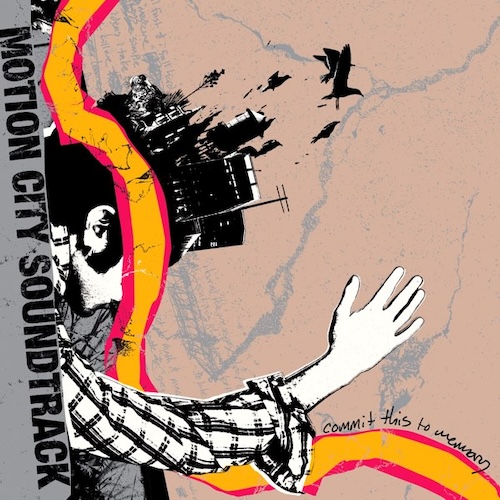
By the mid-2000s, pop-punk and emo's stock was seemingly on the decline. blink-182 were in the midst of their first hiatus while torch-bearers like Green Day and My Chemical Romance were pushing the genre toward theatrical, high-concept rock operas. The landscape had shifted from reflecting mundane, suburban life to something far more intangible. While the genre's scope was expanding outward, Motion City Soundtrack retreated inward, and their 2005 album Commit This to Memory proved to be one of the most personal records of the decade.
Conceived primarily while frontman Justin Pierre was seeking treatment for alcoholism, the album serves as a raw narrative of the psychological whiplash inherent to addiction. Tracks like Resolution represent the occasional moment of clarity. Pierre (or a mirrored protagonist), armed with a heightened sense of self-awareness, recognizes the burden his drinking is placing on those around him. The resulting strain on his relationships encourages him to finally seek help. Meanwhile, tracks like L.G. FUAD undermines that maturity as Pierre gives in to his destructive desires and embraces a childlike incompetence.
Addiction isn't the only ailment presented on this album; it is merely one factor in a mind already at war with itself. Everything Is Alright pulls back the curtain further, revealing that Pierre grapples with the restless, obsessive loops of OCD and anxiety. Here, the alcohol is a coping mechanism that allows him to feign a sense of calm. The song's central irony lies in the title, a frantic, repeated assurance to both himself and his loved ones that he is fine even as every lyrical detail suggests he is anything but.
This defensive posture often leads to a self-imposed exile, a theme explored on Better Open the Door. While most people view the weekend as a sanctuary from the work week, Pierre views the lack of structure as a threat. The line 'Our hell ends every weekend, but it's all I have to believe in' suggests that for a person prone to toxic social outbursts and embarrassing displays, the freedom of the weekend is merely an invitation for self-destruction. To prevent infecting others with his presence, he chooses isolation, effectively locking the door on the very support systems he needs.
Perhaps the most poignant moment on the record, however, comes when the perspective shifts away from Pierre entirely. Time Turned Fragile is written from the viewpoint of a proud, compassionate father. We listen as he dredges up memories of Pierre's childhood as a way to bridge the distance between them. The heartbreaking observation: 'You used to say that you're just fine, but I still wonder all the time,' is a devastating moment for the listener. We, the audience, are fully aware of the chaos Pierre is enduring, yet his father is potentially left in the shadows. It feels quite tragic considering that who could possibly be Pierre's biggest champion in recovery is kept the furthest away out of shame, fear of disappointment, or something else.
One would expect the discussion of such heavy topics to result in a bleak, mid-tempo slog, but Motion City Soundtrack counters the weight with incredibly peppy performances, lively arrangements, and disarmingly campy, Rentals-esque Moog synth lines. Drummer Tony Thaxton is largely responsible for maintaining a high level of energy and that presence is felt right from the very first track, Attractive Today, where he unleashes some fairly flashy drum fills. He also exhibits some of that Travis Barker technical prowess towards the end of Time Turned Fragile when he strings together tom rolls, lightning quick cymbal chokes, and bell accents into an athletic display. Even when the beat is more straightforward, like on Hangman, he plays with a muscular authority that is just as captivating.
In addition to having the ability to spin these personal narratives, Pierre also proves to be a very capable performer who can be both quietly introspective and animatedly powerful. On the chorus of Better Open the Door, Pierre executes an impressive acrobatic leap to the top of his register, textured with just enough vocal fry to really drive the sense of anguish home. He can also exhibit fearlessness, as demonstrated on the bridge of Hangman where a falsetto vocal line is delivered so sour and out of key, that it initially will rub you the wrong way. Only after understanding the record's mental instability does the risky vocal line begin to feel perfectly apt.
The songs that best showcase Motion City Soundtrack's lively arrangements are L.G. FUAD, and again, Time Turned Fragile. The former is structured like a literal rollercoaster where the verses function as either tension-building cable lifts or dramatic drops; each plunge is thrillingly steeper than the last. The latter is surprisingly the album's most energetic cut despite its heart-wrenching sentiment. The main synth line rapidly glides through large interval leaps, immediately making that clear. There's also a dynamic moment in the middle where a brief acapella is interrupted by synchronized jolts from the band. In the last leg where Pierre's father is sharing some moving admissions, the energy is brought way down leaving gentle guitars and softly marching snares.
Commit This To Memory succeeds because it was able to hide the pill. By wrapping a very serious album about addiction and anxiety in a peppy, energetic veneer, Motion City Soundtrack gave audiences an approachable vehicle with which to access these difficult topics. While I also admire the ambition and world building present in some of the decade's biggest records, it turns out that the introspective, personal narratives proved to be more compelling and humanly resonant twenty years later.