
Standout Songs:
Genre:
Label:
Year:
Date Reviewed:
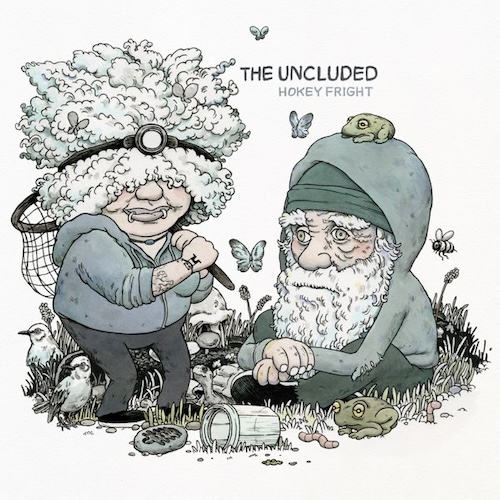
At first glance, The Uncluded is a duo that appears to be made up of two radically different artists. On one side, you have Kimya Dawson, a lo-fi, anti-folk hero whose timid, soft-spoken delivery, conversational songwriting, and homespun production style endeared many. Especially after being prominently featured on the soundtrack to the beloved coming-of-age film Juno. On the other side stands Aesop Rock, an underground hip-hop heavyweight whose extensive vocabulary and dense use of figurative language can have audiences scratching their heads trying to decipher what he's saying. Yet, the moment you hear their worlds collide on their 2013 collaborative record, Hokey Fright, you can start to hear the logic behind their alliance. Despite the differences in their mediums, Dawson and Aesop Rock have quite a bit in common. Both possess an incredibly verbose writing style that yields hyper-vivid, storytelling that penetrates deep to the soul. They could be considered idiosyncratic, quirky, or having an irreverent sense of humor that can dispel tension or shed light amidst thematically dark territory. Which segues into the reason for the duo's inception; both artists were navigating profound personal losses around the time, and formed this unlikely songwriting partnership to collectively process their grief.
As a result, Hokey Fright's songwriting frequently circles back to the concept of death. Yet, rather than explicitly unpacking their thoughts and feelings, the duo processes their grief through a series of gripping tales. On TV on 10, Dawson perfectly captures the anxiety of a nervous flier, hyper-fixating on the impossibly low, yet terrifyingly non-zero probability of an aviation disaster. Aesop Rock's perspective transmits from the safety of the family den, painting a vivid portrait of a young child stumbling upon a breaking news broadcast of a plane crash. Morbid curiosity locks the kid to the screen as the tragedy unfolds, culminating in the sudden, gut-wrenching realization that a close friend's mother was on that flight.
The ripple effects are examined more closely on the following track Earthquake. Here, Dawson heartbreakingly details a young boy in the wake of his mother's sudden passing, entirely too small to comprehend why she is suddenly gone. To offer a point of comfort, she illustrates that the mother is reincarnated as a backyard bird that keeps a watchful eye over the boy. Aesop Rock's verses ground this fable in a harsh reality, delivering a dense commentary on the sheer, cold randomness of tragedy and the unpredictable shockwaves it leaves behind in a community.
Even when the duo approaches the topic with a lighter framing, they still manage to tug hard on the heartstrings. The fittingly titled Organs plays out like a silly public service announcement for organ donation. Aesop Rock describes the physical logistics of the procedure, “turning goodbyes into good biology" as he poetically puts it, with a cold and clinical approach to his complex prose. Dawson takes a simpler, more human approach by depicting a grieving mother who embraces the young boy who received her deceased daughter's heart. On a personal note, the duo takes some time to eulogize their mutual friend, notable underground hip-hop artist Eyedea, on Bats. Although, they still apply their boundless imagination in the process. Amidst allusions to his skills, his character, and his connection to the twin-cities, the duo spins a story of late night pilgrimages to a bridge where a small colony of bats can be seen flying erratically over the water. For the onlookers hoping for a grand, cinematic display of nature to grant them spiritual closure, the moment is an underwhelming disappointment. Yet, for Aesop and Dawson, their perspective is different; a poignant reminder that it isn't the grand, sweeping gestures that save us from grief, but the small, foundational, and routine things in life that keep you moving forward.
Hokey Fright does occasionally manage to break its fixation on mortality, pivoting to analyze the strange ways human beings struggle to connect with one another. The bleak Alligator takes a sobering look at modern intimacy, with Dawson recounting a cold, detached sexual encounter. She looks outward, noting how the culture around her treats sex as an entirely impersonal, self-gratifying transaction. Aesop Rock steps in to provide the psychological origin story for this coldness, illustrating young, impressionable minds receiving their formative sexual education through crude VHS tapes and objectifying skin mags. You can easily make the connection between the warped perception of intimacy and the hollow experiences Dawson describes.
On a slightly warmer, more hopeful tone, Delicate Cycle further analyzes that interpersonal disconnect. Aesop Rock expresses a desperate desire to be physically and emotionally present for those close to him by symbolically offering up every part of his body. Yet, the unstable mental cycles keep him locked away in his own head. Dawson beautifully counterbalances this heavy introspection by dredging up salient anecdotes that underscore the vital importance of actively seeking out and fostering a sense of community. At its absolute lightest, the record will occasionally offer a couple of absurd reprieves that beautifully cut the thick tension. Whether they are rifling off various deli orders on Superheroes, or engaging in an endless game of phone tag on WYHUOM, these moments of pure fun prove that Hokey Fright isn't solely an exercise in processing trauma.
For the vast majority of Hokey Fright, the duo strikes a balance between easily understood, conversational storytelling and cryptic prose, allowing the listener to gradually peel back its thematic layers over time. However, there are times when Aesop Rock leans into his most esoteric tendencies, and Dawson will surprisingly follow suit. On tracks like Eyeball Soup and The Aquarium, the songwriting feels quite impenetrable. Without a narrative thread to pull on, I struggle to connect to these tracks. If the duo is willing to meet me halfway, I'm more inclined to put in the effort in deciphering the meaning of their work.
While Dawson and Aesop Rock are almost always on the same page lyrically, their respective production styles can feel like a tug-of-war. The record attempts to strike a balance between Dawson's lo-fi, voice-memo aesthetic and Aesop Rock's more pristine studio production. Generally speaking, when a track is built around a skeletal idea tabled by Dawson, Aesop sometimes opts to leave it relatively raw and unchanged, simply layering his own vocals and some sparse instrumentation over the top.
Because of this approach, it is often impossible to ignore the noisy room tone baked directly into Dawson's source files. Sometimes, Aesop integrates this atmospheric trait appropriately. On Bats, Dawson's fidelity-warbled, mournful acoustic chord progression is expertly tucked into the background, anchoring a lumbering, slo-mo boom-bap beat. Too often though, the seams are glaringly obvious, particularly in the vocals. Hearing Dawson's raw, demo-quality recordings directly against Aesop Rock's more traditionally tracked vocals can be jarring, resulting in an unharmonious mix that breaks the illusion of them sharing the same room.
Thankfully, this technical disconnect isn't a universal flaw. A track like Delicate Cycle offers a glimpse at what the album could have sounded like with a uniform blueprint. While the song clearly originated from Dawson's anti-folk framework, both the acoustic guitars and her vocals are noticeably upscaled. They mesh better with Aesop's authoritative baritone, his tuned percussion, and a crisp, organic acoustic drum kit. Despite the cleaner recordings, they still possess both Dawson and Aesop Rock's distinct character, proving that the sound is more derived from their performances than recording aesthetics.
While it's not the most organized collaboration and it does require effort to pull out the themes, it does feel fairly apt for a record born out of grief. Grief is messy, it takes work to process, and it can leave you feeling a whirlwind of emotions. Some of which are incoherent. So in that respect, I do find this record to be quite interesting. It's also quite novel given how seemingly different Kimya Dawson and Aesop Rock's respective worlds are. The marriage of tender acoustic folk and brash hip-hop wasn't always executed well, but there's more than enough material here to prove that common ground can be reached.